

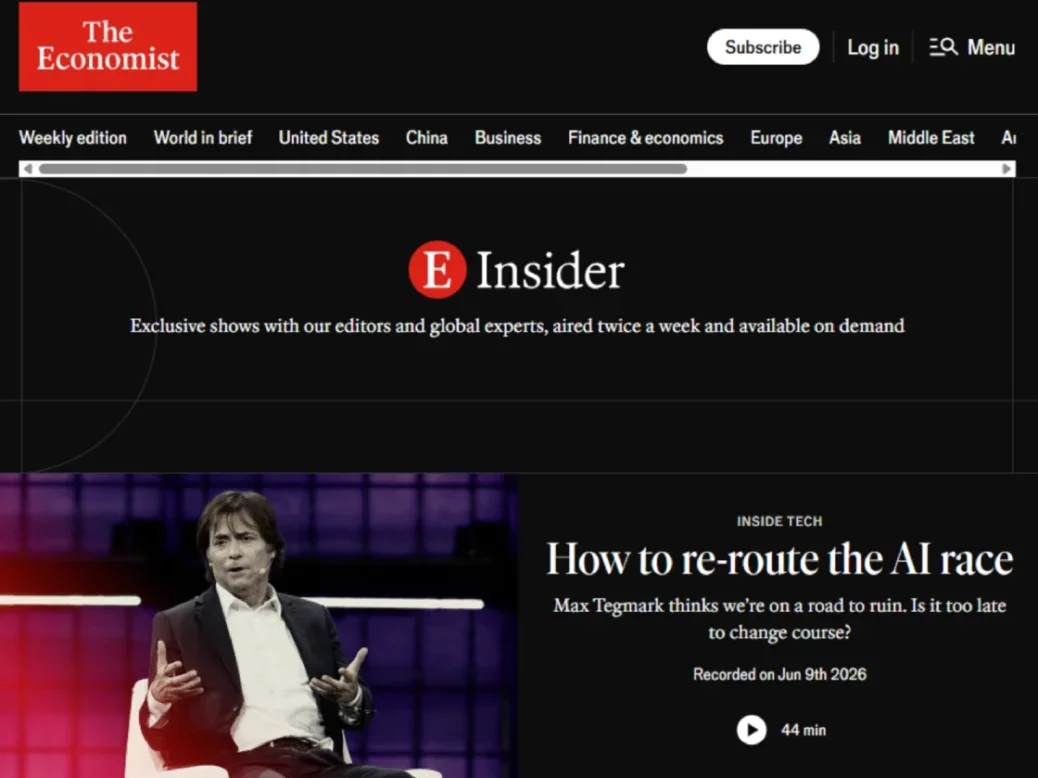
The launch of The Economist’s premium video strand Insider last year has led to a “significant improvement” in subscriber retention.
Economist Insider launched in October as a way to add “extra value” to subscriptions.
It is also a new opportunity for sponsorship revenue and is currently supported by AI company Anthropic.
The video offering, supported by a new purpose-built London studio, includes a weekly show from Economist editor-in-chief Zanny Minton Beddoes and an additional show each week hosted by other Economist journalists about different verticals (defence, geopolitics, economics and tech).
Subscribers also receive extra insights via an Insider newsletter.
Diana Babei, principal product manager, told the Audiencers Festival in London on Thursday that since the launch, 75% of Economist subscribers have engaged with Insider.
She was unable to share specific figures but said they have seen a “significant improvement” in subscriber retention “despite the fact there was a price rise going on, and also we saw that many previously digitally dormant subscribers came back to our product because of Insider, which was a great win as well”.
A digital subscription to The Economist currently costs £195.30 for the first year and then renews at £279. At the start of this year it cost £239 at full price and £167.30 for the first year.
Due to a major marketing drive with prominent placements within other parts of the Economist offering, 90% of subscribers are aware of Insider, Babei said.
Surveys have found 94% are “very satisfied” with Insider, which Babei said was” higher than our usual baselines”. She added that “they specifically appreciated the quality of journalism, the depth, and the trusted tone that Insider brought”.
She said Insider videos tended to be most successful if they included “divisive or very well known personalities” such as an interview with Israeli prime minister Benjamin Netanyahu. She also cited videos around key news moments such as Donald Trump’s military operation in Venezuela.
Insider has not taken away from consumption of The Economist’s podcasts, Babei also revealed, saying it “didn’t cannibalise audio usage” even though the products could be said to overlap as they are two different habits.
Insider videos have received 120 million views on social media, which Babei said was “unexpected” and a “nice benefit” but that this has not necessarily translated into new subscribers or app users. She added that they are “thinking about different strategies of how to nurture that audience over time” so that they do ultimately convert.
Babei also said they had experimented with live videos for Economist Insider (which were later available as on-demand videos) but scrapped this as not worth the extra effort.
A key lesson from the launch, Babei said, was that “user convenience is king for habit formation. We were asking a lot from our subscribers, arguably with Insider to watch long form video. We do know that subscribers are busy, but also what they really value most from The Economist is the depth. So we have to find that right balance…”
Currently 80% of engagement with Insider happens in the Economist app, with 20% on the website.
Babei said providing options for users who don’t want long-form video to consume Insider content, such as via chopping up shorter clips and through the newsletter, helped more people get value from it.
Babei added that The Economist has developed “audio mode” for video within the app, which she described as “akin to what you have on Youtube, where you can lock your phone and listen to the video in the background”.
She said they now “want to create a much more integrated experience” such as the functionality on Spotify through which people can switch easily between video and audio.
Babei also said “depth is as important to measure as reach” which means key metrics have included frequency of engagements and sessions over time to ensure “they’re building that habit”.
She added that watch time “is very important and correlates to higher retention”.
Economist Insider was launched in response to the question: “How can we grow our revenue within our current subscriber base without losing those people?”
She said they looked at various “value signals” including the fact that most subscribers are more likely to continue paying if they engage with the app versus the website, and that attending online subscriber events was a “good retention indicator”.
Email pged@pressgazette.co.uk to point out mistakes, provide story tips or send in a letter for publication on our "Letters Page" blog
